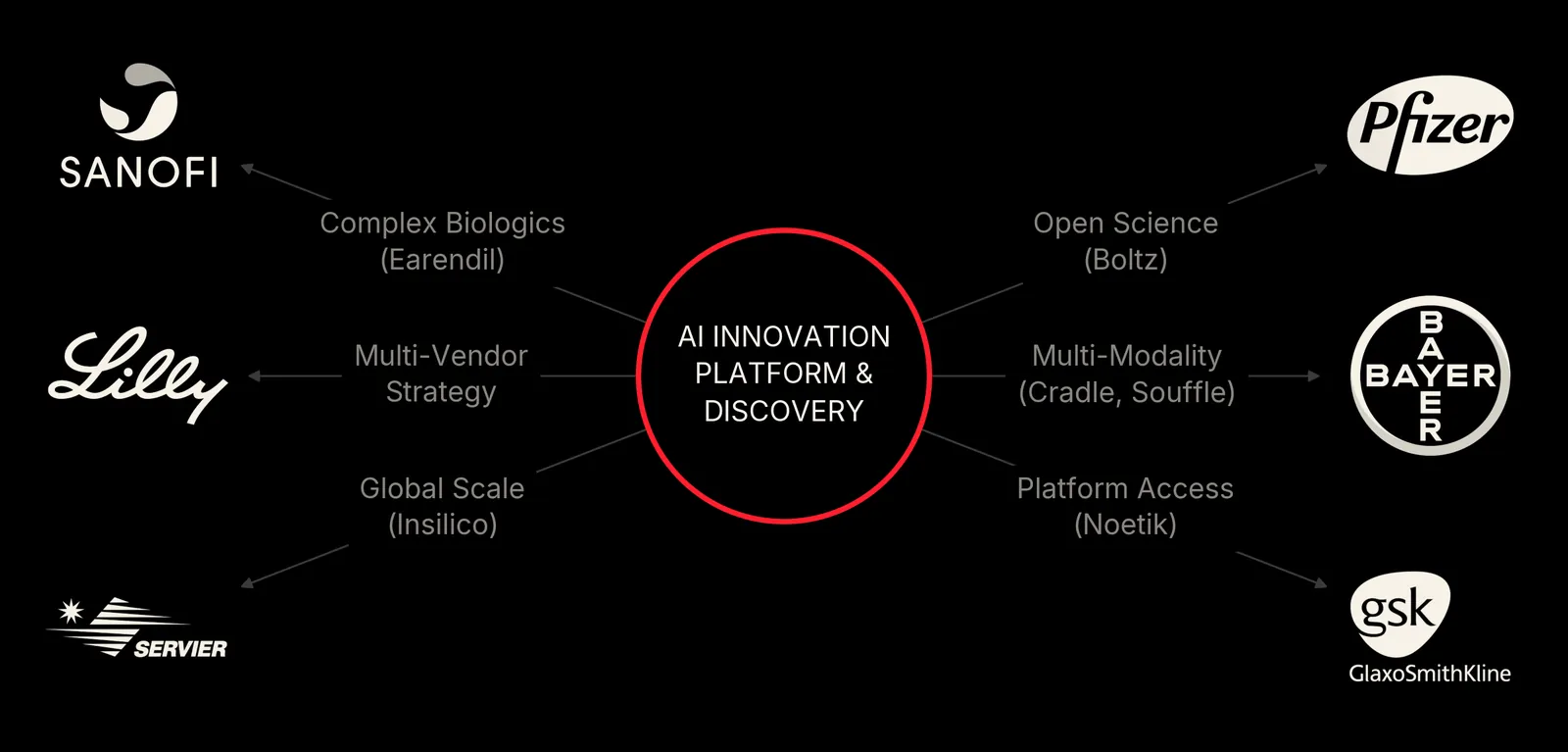
The week leading up to the JP Morgan Healthcare Conference brought a cascade of AI drug discovery announcements. Major partnerships were announced with combined deal values exceeding $5 billion. Pfizer, Bayer, GSK, Sanofi, Eli Lilly, NVIDIA, and Servier all made significant commitments to AI-driven protein and drug discovery platforms.
Here’s what shifted, and what it means for the future of drug development.
The Platform Licensing Shift
The largest deals announced this week weren’t about paying for molecules. They were about licensing platforms.
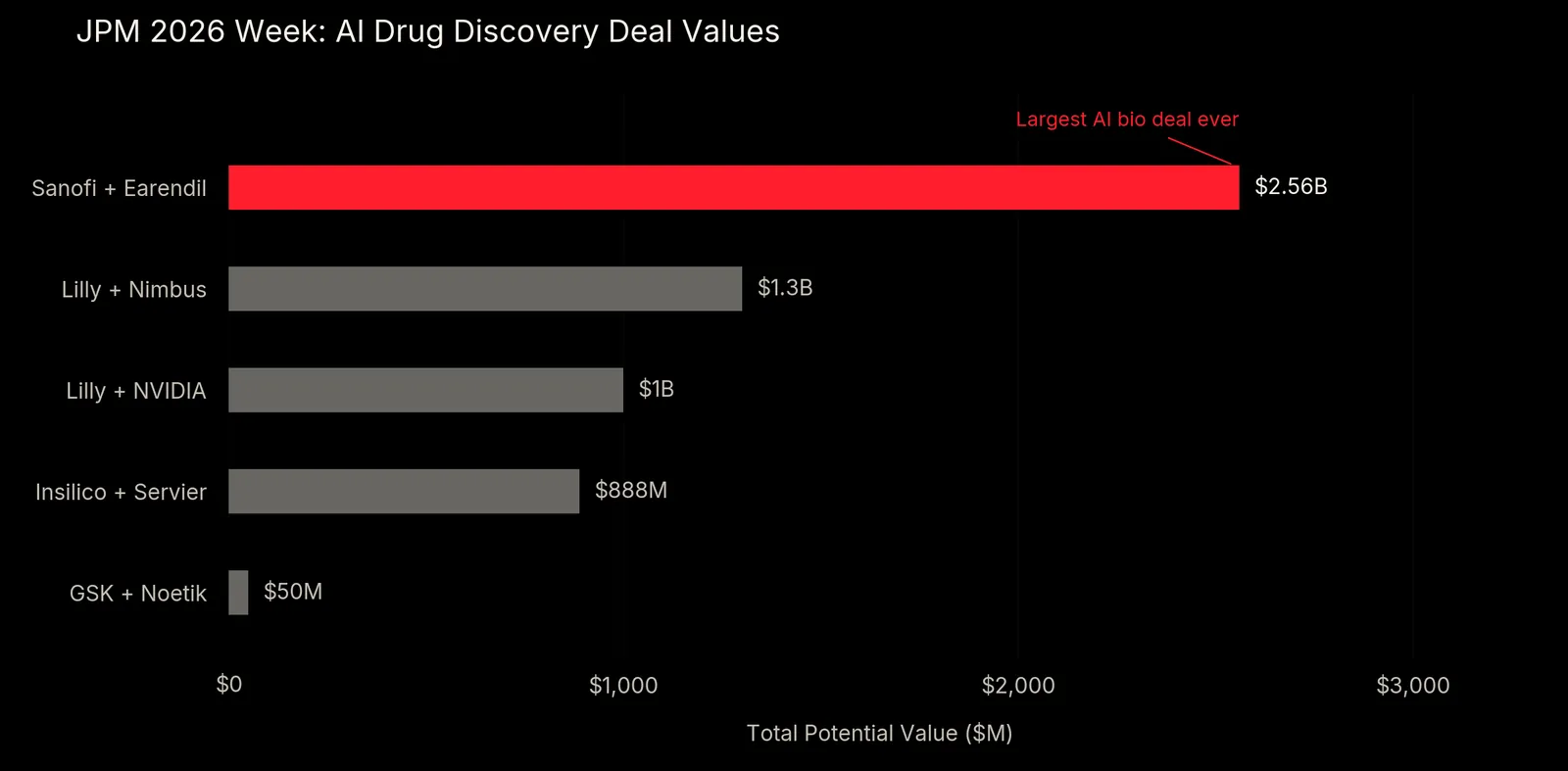
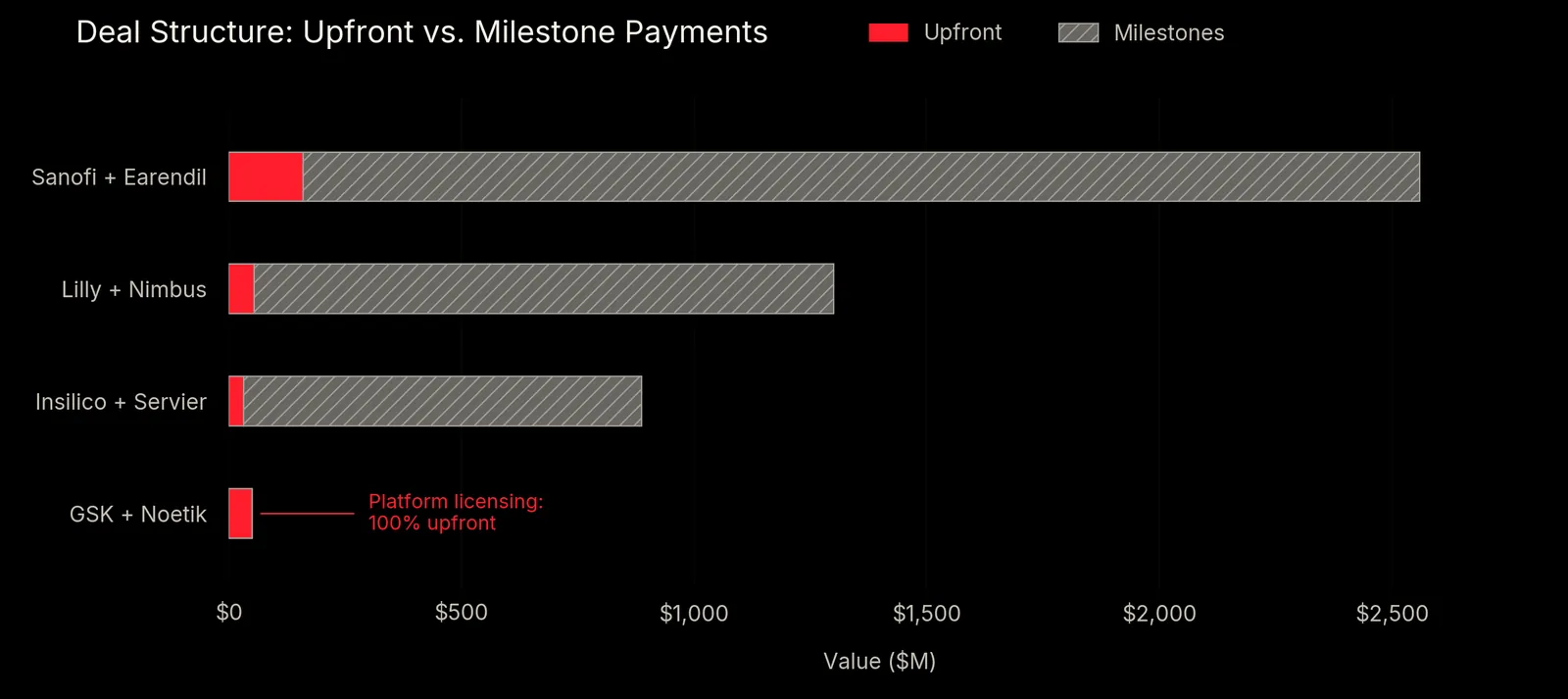
Sanofi made the biggest bet: up to $2.56 billion ($160 million upfront) to Earendil Labs for AI-designed bispecific antibodies targeting autoimmune diseases.1 Earendil is the US affiliate of China’s Helixon Therapeutics, a corporate structure likely designed to maintain access to top-tier global AI talent.
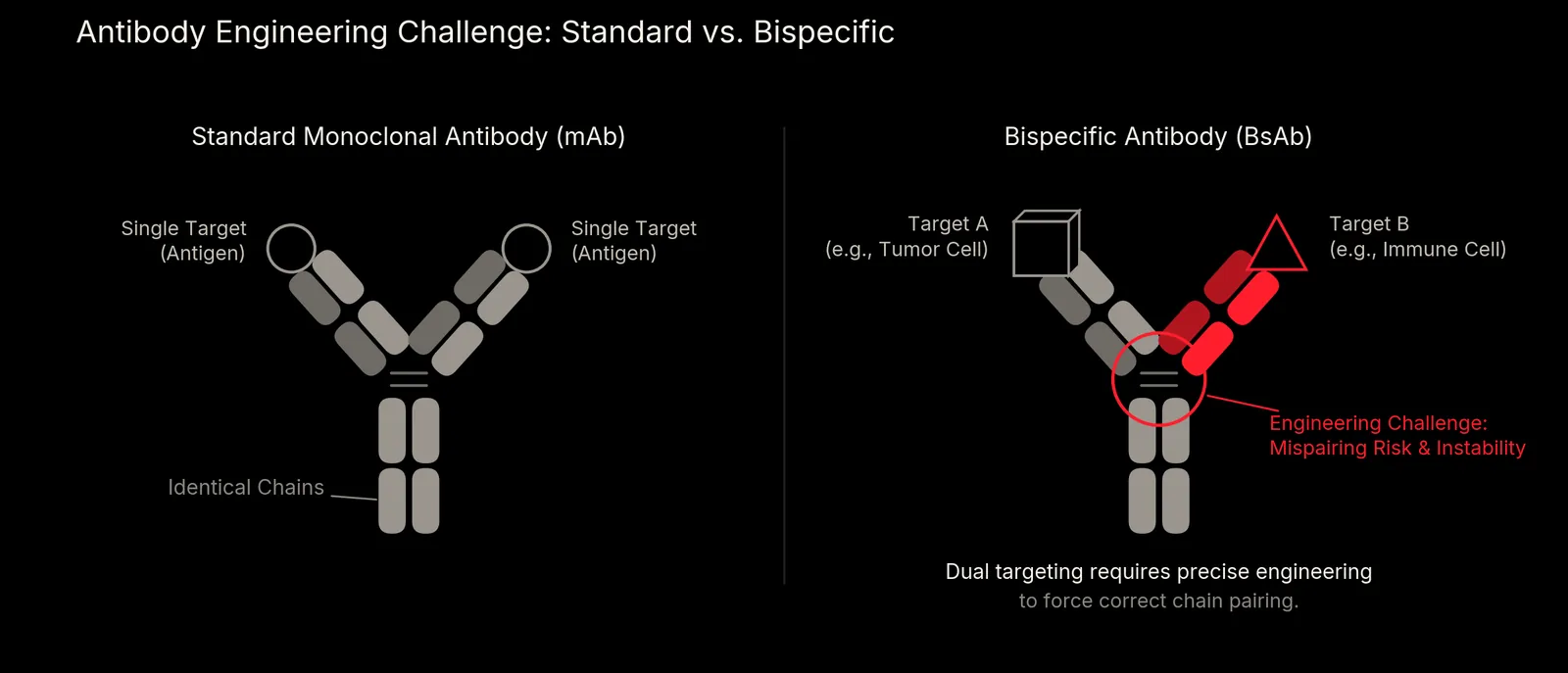
Bispecific antibodies are hard. They require engineering two binding domains that work together without interfering, while maintaining stability and manufacturability. If AI can tackle these challenges, simpler protein therapeutics become table stakes.
Second, the deal structure signals confidence. Sanofi isn’t just paying milestone-based fees for successful molecules (the traditional biotech partnership model). They’re committing substantial upfront capital for platform access across multiple programs.
GSK followed a similar playbook: $50 million in upfront and near-term payments to Noetik for access to virtual cell foundation models.2 GSK isn’t paying for specific drug candidates. They’re paying for the platform itself: the ability to simulate cellular responses and predict drug effects computationally before running wet-lab experiments.
Think of it as SaaS for drug discovery. Pharma is licensing AI infrastructure, not just outsourcing specific R&D programs.
The industry oscillates between platform plays and asset plays. We’re swinging back to platforms. Traditional biotech deals are asset-focused: Company X pays Company Y to develop Drug Z, with milestone payments tied to clinical success. Platform licensing is capability-focused: ongoing access to computational tools that can be applied across dozens of internal programs.
Platform deals create recurring revenue for AI biotechs and give pharma more flexibility. The question is how far this model extends: model licensing, data licensing, or something else entirely.
The Open Science Bet
While GSK and Sanofi were licensing closed platforms, Pfizer made a different bet: open science.
Pfizer partnered with Boltz, a public benefit corporation (PBC) that launched with a $28 million seed round and an explicit pledge: open access to 100,000+ scientists.3 Boltz’s protein structure prediction models (Boltz-1, Boltz-2, and BoltzGen) are freely available, with permissive licensing for both academic and commercial use.
This matters because it represents a direct challenge to closed models like DeepMind’s AlphaFold3. While AlphaFold2 was released openly (and transformed structural biology), AlphaFold3 has restricted access, particularly for commercial drug discovery applications. Google’s Isomorphic Labs licenses AlphaFold-derived tools exclusively to pharma partners, creating a closed ecosystem.
Boltz’s PBC model offers a counter-narrative: open access can coexist with commercial partnerships. The fact that Pfizer (a top-10 global pharma company) is betting on open infrastructure suggests that proprietary moats may not be as defensible as originally assumed.
We’ve seen this movie before in large language models. Meta’s open Llama models didn’t kill OpenAI’s closed GPT-4, but they did create a thriving ecosystem of developers building on open foundations. The protein AI landscape may bifurcate similarly: closed, highly-capitalized platforms (AlphaFold3, Isomorphic Labs) competing with open, community-driven alternatives (Boltz, EvolutionaryScale’s ESM models).
The industry is choosing sides on whether the future of protein AI should be open or proprietary. Pfizer’s partnership with Boltz is a vote for open.
But this isn’t just about software freedom; it is about medical validity. There is a darker risk to closed models: hidden bias. A 2025 systematic review found that 84% of global clinical AI models do not report the racial composition of their training data4. We know that Black participation in pivotal oncology trials often hovers around 5-10% (despite being ~14% of the US population)5. If proprietary models are trained on this skewed historical data without correction, they will optimize drugs for the “average” (White) patient and fail everyone else. Open models like Boltz allow researchers to audit and retune these datasets; closed black boxes do not.
Multi-Modality Strategies Emerge
Bayer’s announcements revealed a different strategic priority: diversification across modalities.
Bayer didn’t make one AI partnership. They made two, in the same week.
First, a 3-year strategic collaboration with Cradle for protein engineering, with Cradle claiming 12x faster development cycles compared to traditional methods.6 This partnership focuses on antibody discovery and optimization, applying AI to engineer proteins with improved stability, binding affinity, and manufacturability.
Second, a partnership with Soufflé Therapeutics for cell-specific heart-targeted siRNA therapy.7 Soufflé uses AI to design RNA-based genetic medicines that selectively silence disease-causing genes in cardiac cells, targeting dilated cardiomyopathy (a rare heart disease).
Bayer’s strategy: don’t bet on a single modality. Apply AI across proteins, RNA, and genetic medicines simultaneously.
AI is no longer confined to one type of molecule. It’s proving useful across proteins, peptides, RNA, and small molecules. Pharma’s challenge now is building internal capabilities (or external partnerships) that span all these modalities.
European Pharma Enters the Race
While US biotech hubs (Boston, San Francisco) have dominated AI drug discovery headlines, European pharmaceutical companies are moving just as aggressively.
Insilico Medicine extended its reach with an $888 million collaboration ($32 million upfront) with Servier, a French pharmaceutical giant, targeting oncology drug discovery.8 This partnership came less than one week after Insilico’s Hong Kong IPO, where they raised $293 million, demonstrating global capital markets’ appetite for validated AI drug discovery platforms.
Servier’s entry is notable because it signals that European pharma isn’t waiting for US companies to prove out AI-driven drug discovery. They’re making comparable-scale bets now. Combined with Bayer’s dual partnerships (Germany-based), European pharmaceutical companies are adopting AI at the same pace as their US counterparts.
The geographic expansion of AI drug discovery partnerships has important implications for the ecosystem. It means:
- More deal flow for AI biotechs: European pharma represents additional partnership capacity beyond US/Japan markets
- Competitive pressure on pharma: If Bayer and Servier secure AI capabilities early, competitors like Roche, AstraZeneca, and Boehringer Ingelheim face “catch-up” risk
- Regulatory implications: European regulators (EMA) will need to develop frameworks for evaluating AI-designed therapeutics, just as FDA is doing
The window for exclusive deals is closing fast. Within 18 months, every top-20 global pharmaceutical company will likely have secured some form of AI drug discovery partnership.
Eli Lilly’s Multi-Vendor Playbook
If there’s one company defining the pharma approach to AI partnerships, it’s Eli Lilly,the world’s first trillion-dollar pharmaceutical company.9
Lilly’s recent partnerships reveal a clear strategy: multi-vendor, diversified bets across different AI platforms.
- Chai Discovery: Participation in a $130 million Series B to accelerate biologics discovery10
- Nimbus Therapeutics: $55 million upfront (plus $1.3 billion milestones) for oral obesity drugs11
- Isomorphic Labs: Multi-target partnership with up to $1.7 billion in milestones12
- NVIDIA: A $1 billion joint investment to build an “AI Co-Innovation Lab” focusing on robotic wet labs and physical AI13
- Schrödinger: A strategic integration embedding Lilly’s proprietary “TuneLab” models directly into Schrödinger’s LiveDesign software14
The NVIDIA and Schrödinger announcements (Jan 12) distinguish Lilly’s strategy. While others are simply licensing software, Lilly is building a modular ecosystem. They use Isomorphic for discovery, Schrödinger as the operating system to run their own “TuneLab” models, and the new NVIDIA-powered robotic lab to physically validate predictions. They aren’t just a customer of AI; they are becoming an AI integrator.
Lilly isn’t putting all its chips on one AI vendor. They’re building a full stack:
- Isomorphic Labs: Discovery and structure prediction
- Schrödinger + TuneLab: Computational chemistry operating system
- NVIDIA: Physical AI and autonomous lab validation
This approach makes strategic sense. AI drug discovery is still nascent; no single platform has proven definitively superior across all target classes and modalities. By partnering with multiple vendors, Lilly hedges technical risk while learning which approaches work best for which problems.
Every major pharmaceutical company will likely copy this playbook. The question isn’t “should we partner with AI biotechs?” but rather “which portfolio of AI partners gives us the best coverage across our pipeline?”
Clinical Validation: The Inflection Point
Partnerships and funding rounds generate headlines, but clinical data determines whether AI drug discovery actually works.
While the Servier deal was announced this week, the scientific validation that likely secured it arrived last year. In mid-2025, Insilico Medicine’s rentosertib (a small-molecule TNIK inhibitor for idiopathic pulmonary fibrosis) delivered positive Phase 2a results published in Nature Medicine.15
The trial demonstrated a dose-dependent improvement in lung function, moving the asset toward Phase 3. This was the industry’s “proof of life”: confirmation that an AI-designed molecule against an AI-discovered target could work in humans.
Servier’s $888 million bet this week isn’t a leap of faith; it’s a trailing indicator of that success. Pharma is no longer testing AI on low-priority backup programs. They are writing checks based on peer-reviewed clinical evidence.
Three things make this milestone significant:
-
Speed: Compressing discovery timelines by 50%+ has massive economic implications. Faster discovery means lower R&D costs, earlier revenue, and more shots on goal within the same budget.
-
Generalizability: Rentosertib isn’t a simple target. TNIK (Traf2- and Nck-interacting kinase) is a difficult kinase to drug selectively. If AI can tackle challenging targets like this, it suggests the approach works broadly, not just for well-characterized proteins.
-
Publishable data: Nature Medicine is a highly selective journal. The fact that Insilico’s Phase 2a data passed peer review signals that the scientific community is taking AI-discovered drugs seriously.
What Changed
The week of January 4-9, 2026 marks an inflection point because three separate trends converged simultaneously:
1. Clinical Validation
Insilico’s rentosertib results prove that AI can compress drug discovery timelines while maintaining (or improving) molecule quality. This isn’t theoretical anymore. It’s reproducible, peer-reviewed clinical data.
2. Business Model Diversification
Platform licensing (GSK-Noetik, Sanofi-Earendil) is emerging as a viable alternative to traditional milestone deals. This creates more predictable revenue for AI biotechs and more flexibility for pharma partners. We’re seeing multiple monetization models coexist: asset deals (Lilly-Nimbus), platform subscriptions (GSK-Noetik), and hybrid models (Sanofi-Earendil).
3. Industry-Wide Adoption
European pharma (Servier, Bayer) is moving as aggressively as US counterparts. Partnerships now span Pfizer, GSK, Bayer, Sanofi, Eli Lilly, Novartis, Novo Nordisk, and Servier. Every major player has secured AI capabilities. The adoption curve has shifted from “early adopters testing a new technology” to “industry-wide standard practice.”
This wave builds on 2024-2025 foundations like Isomorphic Labs’ $1.7 billion deal with Lilly and Generate:Biomedicines’ $1 billion+ partnership with Novartis. But the density of announcements in a single week (six deals, multiple modalities, global geography) signals that the market has figured out what works.
Two Questions That Will Define the Next 24 Months
The next phase of AI drug discovery won’t be about adoption (that’s already happening). It will be about execution and clinical proof at scale.
Two questions will determine the trajectory:
1. Open vs. Closed: Which Model Wins?
Can open science models like Boltz and EvolutionaryScale maintain pace with well-funded closed competitors like AlphaFold3 and Isomorphic Labs? Or will the best models remain behind commercial barriers, accessible only to pharma partners who can afford $50 million+ licensing fees?
This isn’t just a technical question. It’s an ecosystem question. Open models democratize access, enabling academic labs and small biotechs to leverage cutting-edge AI. Closed models concentrate capability among large players with deep pockets.
The LLM market suggests both can coexist. Meta’s Llama models haven’t killed OpenAI’s GPT-4, but they’ve created a thriving ecosystem of developers building on open foundations. Protein AI may follow a similar path: a bifurcated landscape where some applications (academic research, basic discovery) run on open tools while high-stakes commercial programs (pharma drug discovery) use proprietary platforms.
But there’s a risk: if closed models significantly outperform open alternatives, access gaps widen. The companies that can afford Isomorphic Labs partnerships get the best tools; everyone else makes do with second-tier models.
2. Access Equity: Who Gets Left Behind?
As mega-pharma locks in $50 million+ platform partnerships, what happens to smaller biotechs?
Venture-backed biotech companies (10-50 employees, $10-50 million raised) are the traditional engines of drug discovery innovation. But if AI protein design requires $50 million licenses and dedicated computational infrastructure, these companies can’t compete.
The “pay-to-play” barrier is rising. Commercial licenses for top-tier AI drug discovery platforms (like Schrödinger or subscription-based AI suites) often run $500,000 to over $1 million annually16.
For a Pfizer, that is a rounding error. For a Series A biotech with 18 months of runway, it is a hiring freeze. If the best models remain behind these paywalls, innovation will concentrate in the hands of the top 20 pharma companies, squeezing out the startup ecosystem that historically drives early-stage risk taking.
Conclusion: Execution Over Innovation
The fundamentals are now in place:
- Validated models: Protein structure prediction, small-molecule design, antibody optimization all work computationally
- Pharma buy-in: Every major pharmaceutical company has secured AI partnerships
- Clinical proof: Insilico’s rentosertib demonstrates AI-discovered drugs can reach late-stage trials with positive data
- Diverse business models: Platform licensing, milestone deals, and hybrid structures all exist
The next 24 months won’t be about proving AI drug discovery works. That question is answered. The focus now shifts to:
- Execution: Can AI biotechs deliver multiple clinical candidates, not just one success story?
- Scalability: Can pharma apply AI across entire pipelines, not just cherry-picked programs?
- Equity: Will access remain broad, or will capability concentrate among the largest players?
The answers will determine whether AI accelerates drug discovery broadly, or concentrates capability among those with the deepest pockets.
The inflection point has arrived. Now we find out if the hype was justified.
References
- Sanofi-Earendil Labs partnership: https://www.fiercebiotech.com/biotech/sanofis-latest-autoimmune-bispecific-pact-ai-biotech-could-reach-25b
- GSK-Noetik deal: https://www.fiercebiotech.com/biotech/gsk-inks-model-deal-50m-bet-noetiks-cancer-ai-platform
- Boltz-Pfizer collaboration: https://www.prnewswire.com/news-releases/boltz-and-pfizer-announce-strategic-collaboration-to-develop-and-deploy-state-of-the-art-biomolecular-ai-foundation-models-302656405.html
- AI Training Data Transparency: “Gender and racial bias unveiled: clinical artificial intelligence (AI) and machine learning (ML) algorithms.” JMIR Medical Informatics, 2025.
- Clinical Trial Disparity: “Rooting Out AI’s Biases.” Johns Hopkins Bloomberg Public Health, Nov 2023.
- Bayer-Cradle partnership: https://www.prnewswire.com/news-releases/bayer-and-cradle-enter-collaboration-to-enhance-ai-enabled-antibody-discovery-and-optimization-302654710.html
- Bayer-Soufflé Therapeutics siRNA partnership: https://www.businesswire.com/news/home/20260107052121/en/Bayer-and-Souffl-Therapeutics-Announce-Strategic-Collaboration-to-Advance-Cell-Specific-Heart-Targeted-siRNA-Therapy
- Insilico-Servier deal: https://www.fiercebiotech.com/medtech/insilico-fresh-its-hong-kong-ipo-pens-potential-888m-cancer-rd-pact-servier
- Eli Lilly trillion-dollar milestone: https://www.biopharmadive.com/news/eli-lilly-1-trillion-pharmaceutical-market-value-obesity/721819/
- Eli Lilly-Chai Discovery partnership: https://www.businesswire.com/news/home/20260108131261/en/Chai-Discovery-Announces-Collaboration-with-Eli-Lilly-and-Company-to-Accelerate-Biologics-Discovery
- Eli Lilly-Nimbus collaboration: https://www.fiercebiotech.com/biotech/lilly-returns-nimbus-13b-deal-create-new-oral-obesity-drug
- Isomorphic Labs-Lilly partnership: https://www.prnewswire.com/news-releases/isomorphic-labs-announces-strategic-multi-target-research-collaboration-with-lilly-302027392.html
- Eli Lilly-NVIDIA AI Lab: https://investor.lilly.com/news-releases/news-release-details/lilly-and-nvidia-partner-physical-ai
- Schrödinger-Lilly Update: https://ir.schrodinger.com/press-releases/news-details/2026/Schrdinger-Provides-Update-on-Progress-Across-the-Business-and-Outlines-2026-Strategic-Priorities/default.aspx
- Insilico rentosertib Nature Medicine publication: https://www.nature.com/articles/s41591-025-03743-2
- AI Platform Pricing Models: “Pricing AI in Drug Discovery: Balancing Success Rates and Research Timelines.” Monetizely, June 2025.
About This Post
This analysis synthesizes AI drug discovery partnerships announced around the JP Morgan Healthcare Conference 2026. All deal values and clinical data are sourced from company press releases and peer-reviewed publications.